This post is a part of an ongoing series of discoveries about the new evangelization. (Find out more here.) Today, I spent some time looking at the first occurrence of a parable in the Gospels: What was it about? What message did Jesus have for the kingdom? Instead, I got very interested in the question the disciples asked Jesus. Essentially, they wanted to know why Jesus spoke in parables. So do I . . .
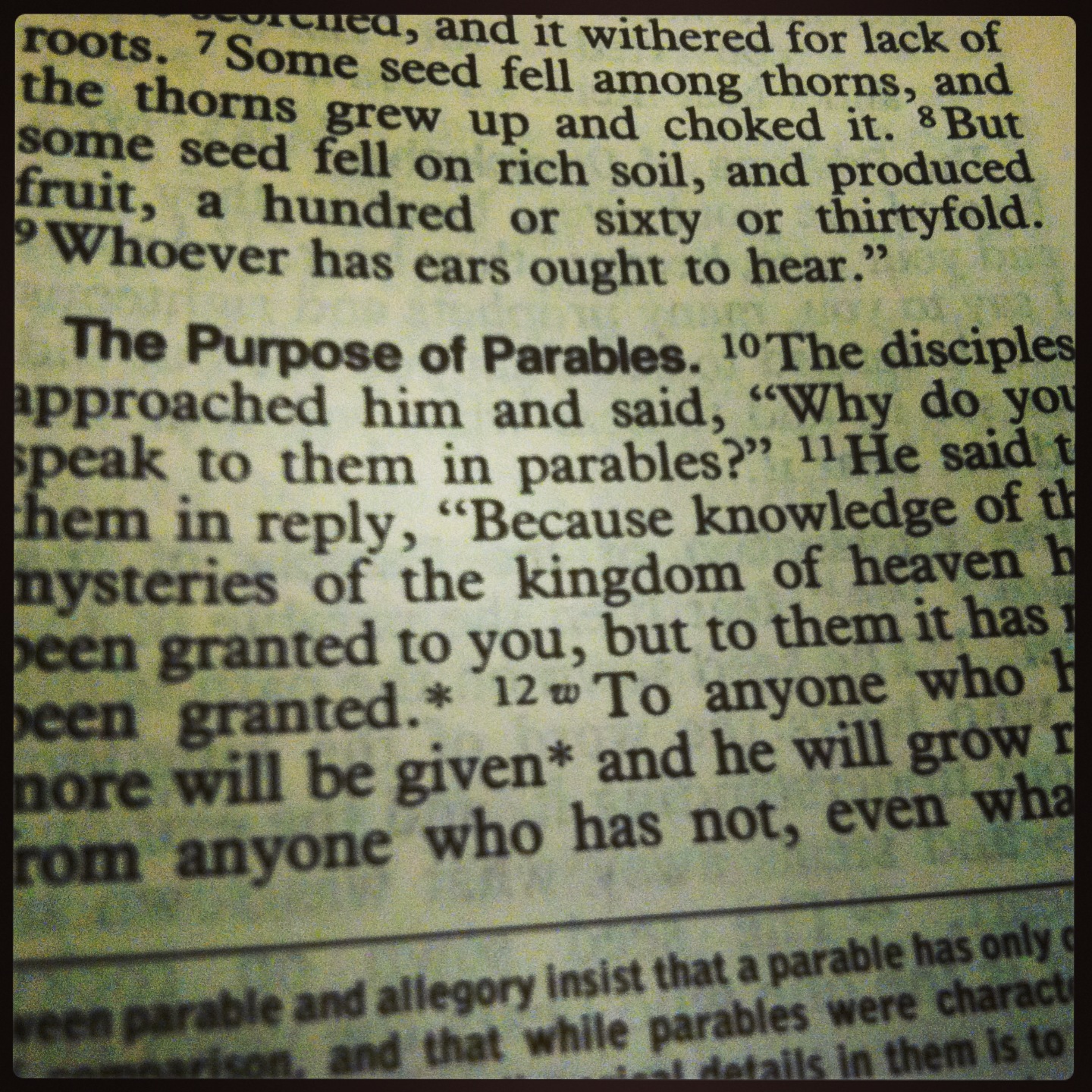
Immediately after Jesus offered a parable for the first time, his confused disciples ask him why. Look at the way Matthew describes this event and keep in mind the audience of people Jesus is trying to reach in his parables:
The disciples approached him and said, “Why do you speak to them in parables?” (Mt 13:10)
Matthew makes it clear that the parables, at least in this case, are meant for the people who have not become disciples yet. At the beginning of chapter 13, it is clear that Jesus “sat down by the sea” and spoke to “large crowds” (Mt 13:1-2). The crowds, we can assume, are not yet committed (intentional) disciples.
So, why does Jesus preach in parables? Here is his answer:
“Because knowledge of the mysteries of the kingdom of heaven has been granted to you [the disciples], but to them [the crowds] it has not been granted.” (Mt 13:11)
Jesus didn’t “teach” in parables, he “preached” or “proclaimed” in parables. Each parable taught a lesson about the Kingdom of God, which Matthew connects to the act of proclaiming. Teaching, on the other hand, is something Jesus does in the synagogue or in this case to his disciples in private. His disciples receive teaching about the mysteries of the kingdom, but the crowds—those in need of evangelization—are taught in parables because presently they “see and hear but do not listen and understand” (Mt 13:13).
In other words, we can’t teach the unevangelized.
We can’t expect them to understand the mysteries because they are not ready yet. Matthew drives this point home invoking the prophet Isaiah who describes a people who “hardly hear with their ears” and “have closed their eyes” because they do not “see with their eyes and hear with their ears and understand with their hearts and be converted and I heal them” (Mt 13:15; Is 6:10).
To be converted, we must first be healed by Jesus. But what’s next? Teach them all their is to know? Not yet. For the lost—those who cannot see or hear yet—they need something different. They need the first proclamation (the kerygma). They need parables about the kingdom first. They need to understand what the kingdom of God is really all about, otherwise all that religious stuff will just seem like crazy talk.
Click here to learn more about the Heal, Proclaim, and Teach approach to evangelization.





This is why Nehemiah sent catechists into the crowd listening to the reading of the Law to answer questions and make clarifications. And the people wept.